
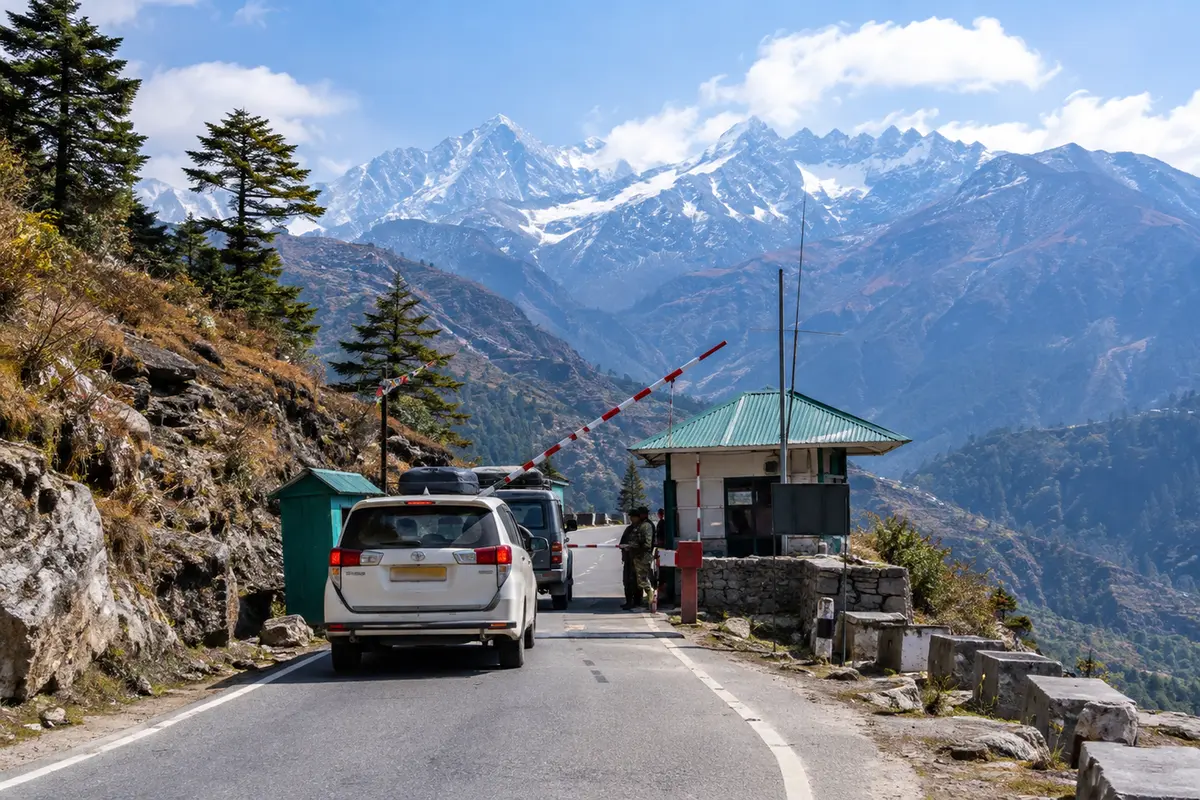
Planning a trip to Lachen, Lachung, Yumthang Valley or Gurudongmar Lake? Understanding the North Sikkim permit requirements is one of the most important parts of planning your journey. Unlike regular tourist areas in Sikkim, several destinations in North Sikkim fall within protected border areas, so travellers cannot simply drive there without the required permission.
For Indian travellers, a Protected Area Permit (PAP) is required for the designated protected areas beyond the regular tourist circuit. Foreign nationals follow additional Restricted Area Permit (RAP) and PAP requirements, and some North Sikkim destinations have restrictions on foreign visitors.
The permit process is generally handled through authorised local travel agencies or tour operators rather than as a simple walk-in tourist application. Documents, photographs, route details and travel dates may be required before the journey.
If you are planning the complete circuit, you can also check our North Sikkim Tour Package from Kolkata – 5 Nights 6 Days to understand how the permit-controlled destinations fit into a practical travel plan.
This guide explains the North Sikkim permit process in simple terms, including who needs a permit, documents required, where permits are arranged, important rules, foreign traveller restrictions, common mistakes and useful 2026 travel tips.
Why Do You Need a Permit for North Sikkim?
North Sikkim is not an ordinary open tourist zone. Several areas lie close to India’s international borders and are therefore classified as protected areas.
The permit system helps the authorities regulate tourist movement in sensitive border regions, maintain security, manage traffic and control access during difficult weather or road conditions.
Places such as Lachen, Gurudongmar Lake, Lachung, Yumthang Valley and Yumesamdong fall within the protected North Sikkim travel corridor. The exact area covered by a permit depends on the route and the destinations mentioned in the approved travel plan.
This means that having permission to travel to one part of North Sikkim does not automatically mean that you can freely visit every restricted location.

Is a North Sikkim Permit Mandatory for Indian Tourists?
Yes. Indian tourists travelling to designated protected areas of North Sikkim need the applicable Protected Area Permit.
This is particularly important for travellers going towards:
- Lachen
- Gurudongmar Lake
- Thangu and higher areas on the Lachen route
- Lachung
- Yumthang Valley
- Yumesamdong or Zero Point, subject to current access
- Other protected locations specifically mentioned in the approved route
The permit requirement can also be affected by temporary administrative, security, road or weather restrictions.
Therefore, do not assume that a permit issued for an earlier trip will remain valid for your next visit.
Which Places in North Sikkim Require a Permit?
One of the easiest ways to understand the system is to separate normal Sikkim sightseeing from protected North Sikkim travel.
Gangtok, for example, is a regular tourist base and does not require the same North Sikkim PAP simply to stay in the city. The requirement begins when your journey enters the designated protected routes.
The following table gives a practical overview.
| Destination | Permit relevance | Important note |
| Lachen | PAP required | Access depends on current road and administrative clearance |
| Gurudongmar Lake | PAP required | Indian tourists are permitted subject to current rules |
| Thangu | Protected route | Usually associated with the Lachen/Gurudongmar circuit |
| Lachung | PAP required | Permit and route conditions apply |
| Yumthang Valley | PAP required | Access depends on current route permission |
| Yumesamdong / Zero Point | Protected route | Separate access may depend on current permit and road conditions |
| Gangtok | No North Sikkim PAP simply for city stay | Used as the common base before entering North Sikkim |
The list above should be treated as a travel-planning guide rather than a substitute for the permit issued for your specific journey. Protected-area access can change because of weather, road damage, military restrictions or local administration.

For a detailed sightseeing plan, you can also explore our guide to Places to Visit in North Sikkim before finalising your route.
North Sikkim Permit Types Explained
The terminology around Sikkim permits can sometimes be confusing because different categories apply to Indian and foreign travellers.
For most Indian tourists travelling to North Sikkim, the important term is Protected Area Permit or PAP.
Foreign nationals have additional entry requirements because Sikkim itself is under a Restricted Area Regime. They may require a Restricted Area Permit or RAP, followed by permission for eligible protected areas.
Protected Area Permit (PAP)
A PAP is the key permit associated with protected border areas of Sikkim.
For North Sikkim, the protected routes include the Lachen/Gurudongmar and Lachung/Yumthang/Yumesamdong axes.
The permit identifies the approved travel area and helps authorities regulate tourist movement through sensitive regions.
Restricted Area Permit (RAP) for Foreign Nationals
Foreign nationals face additional restrictions.
The Government of Sikkim states that foreign nationals require a Restricted Area Permit to enter Sikkim, while additional protected-area permissions apply for eligible border regions.
Not every protected destination is available to foreign visitors. In particular, destinations such as Gurudongmar Lake have restrictions that do not apply in the same way to Indian citizens.
Foreign travellers should therefore never assume that an itinerary available to Indian tourists is automatically available to them.

Documents Required for North Sikkim Permit
Keeping the correct documents ready can make the permit process much smoother.
For Indian travellers, travel operators generally ask for valid government-issued photo identification and recent passport-size photographs. The exact document requirements can vary according to the issuing authority and current rules, so travellers should confirm the accepted ID before submitting documents.
A practical document checklist includes:
- Valid government photo ID
- Photocopies of the required ID
- Recent passport-size photographs
- Child-specific identification or supporting documents where applicable
- Travel dates
- Names of all travellers
- Planned North Sikkim route
- Any additional document requested by the travel operator or authorities
For foreign nationals, passport and valid Indian visa documentation are particularly important, along with the documents required for the RAP/PAP process.
Which ID Proof Should Indian Tourists Carry?
This is an area where travellers should be careful.
Different permit-processing sources may mention different accepted IDs, and requirements can change. Therefore, do not rely on a random blog or an old checklist.
Before travelling, confirm with your registered travel operator which original ID and photocopies are currently accepted for the specific North Sikkim permit.
It is also sensible to carry the original document during the journey because security personnel may check identity at different points.
How Many Passport Photos Are Needed?
Recent passport-size photographs are commonly requested for permit processing.
Because the number can vary according to the current procedure and traveller category, carrying a few recent photographs per traveller is a practical precaution.
Photographs should be clear and recent, and travellers should avoid waiting until reaching Gangtok to arrange them if their operator has already requested them.

How to Apply for a North Sikkim Permit
For most tourists, the easiest approach is to arrange the permit through a registered local travel agency or tour operator.
The Government of Sikkim’s current guidance states that permits for protected areas including the North Sikkim routes are issued through authorised channels, including registered local travel agencies/tour operators.
The basic process usually works like this:
Step 1: Finalise your North Sikkim itinerary
Decide whether you are travelling towards Lachen and Gurudongmar, Lachung and Yumthang, or following a combined itinerary.
Step 2: Submit traveller details
Provide the required ID documents, photographs and traveller information to your tour operator.
Step 3: Permit application
The authorised agency submits the permit application through the applicable government/authorised system.
Step 4: Administrative and security clearance
The application is processed according to the current rules, route conditions and applicable clearances.
Step 5: Permit issuance
Once approved, the permit is issued for the permitted route and travel period.
Step 6: Carry the permit during travel
Do not leave the permit behind at the hotel. Your route may include multiple check posts where documents can be verified.

How Early Should You Apply for a North Sikkim Permit?
Do not leave the permit process until the morning of your journey.
Sikkim authorities have previously specified advance permit issuance for North Sikkim routes, including a rule that same-day permits should not be issued for the Lachung axis.
In practice, it is better to provide your documents to the travel operator as early as possible, especially during:
- Peak holiday periods
- Winter snowfall periods
- Long weekends
- Christmas and New Year
- School holidays
- Periods of heavy tourist demand
Early document submission also gives your operator time to address problems if an ID copy, photograph or traveller detail needs correction.
Can You Get a North Sikkim Permit Yourself?
For ordinary tourists, North Sikkim permit processing is generally not as simple as buying a regular sightseeing ticket.
The Government of Sikkim identifies registered local travel agencies and tour operators as an authorised route for processing permits for protected areas.
That is why North Sikkim trips are commonly organised through registered operators, particularly when the itinerary includes Lachen, Gurudongmar, Lachung or Yumthang.
Trying to arrange everything independently without understanding the current permit system can create unnecessary problems at the check post.
For travellers coming from Kolkata, it is useful to understand the complete route before booking. Our guide on How to Reach North Sikkim from Kolkata explains the journey from Kolkata towards NJP/Bagdogra, Gangtok and onward North Sikkim travel.
North Sikkim Permit Rules for Indian Tourists
Obtaining a permit does not mean that travellers can move freely throughout the region.
Your trip must follow the route and destinations approved under the permit.
Some important rules include:
- Travel only through permitted routes.
- Do not enter restricted areas that are not mentioned or authorised.
- Follow instructions from police, army and local authorities.
- Carry your permit and original identification.
- Follow the approved itinerary.
- Respect local environmental and community rules.
- Do not ignore temporary road closures or security instructions.
- Follow instructions when a route is closed because of weather or landslides.
The Government of Sikkim has specifically stated that tourists must remain within the areas specified in their permits and that unauthorised travel can attract penalties.
Why Can a Permit Be Refused or Delayed?
A permit is not an unconditional guarantee of travel.
Processing or travel can be affected by:
- Road damage
- Landslides
- Heavy snowfall
- Extreme weather
- Security restrictions
- Administrative orders
- Temporary closure of a destination
- Incomplete documentation
- Changes in the permitted travel route
This is especially relevant in North Sikkim because road conditions can change quickly.
Therefore, even after your documents have been submitted, keep some flexibility in your travel plan.
North Sikkim Permit Rules for Foreign Nationals
Foreign nationals need to be more careful when planning North Sikkim.
The entry requirements for foreign visitors are different from those for Indian citizens. A foreign traveller may require an RAP for entering Sikkim and additional permission for eligible protected areas.
Some destinations have stricter restrictions.
For example, foreign tourists cannot simply follow the same Lachen–Gurudongmar itinerary commonly available to Indian travellers. Gurudongmar Lake has specific restrictions for foreign nationals.
Foreign visitors should therefore provide their nationality and passport details to the registered operator before booking a North Sikkim itinerary.
The operator can then verify whether the requested route is currently available for that traveller category.
Does the Permit Cover Gurudongmar Lake and Yumthang Valley?
The answer depends on the route and the permission issued for your trip.
Gurudongmar Lake belongs to the Lachen side of the North Sikkim circuit, while Yumthang Valley is accessed from Lachung.
They are therefore not simply interchangeable destinations under one unrestricted tourist pass.
If your itinerary includes both sides, your operator needs to arrange the travel permissions according to the approved route and current rules.
This is one reason a properly planned North Sikkim 5 Nights 6 Days Itinerary is useful before submitting your permit documents. Your permit should match the actual travel plan rather than an incomplete or outdated itinerary.
North Sikkim Permit Cost in 2026
Many travellers search for the exact North Sikkim permit cost, but this requires some clarification.
The permit itself should not be confused with the total cost of a North Sikkim trip.
Your overall package may include:
- Vehicle charges
- Driver charges
- Accommodation
- Meals
- Local transportation
- Administrative or permit-related charges
- Parking or other route charges
- Applicable government fees
- Operator service costs
Also, permit rules and associated charges can change through government notifications.
For this reason, travellers should ask their operator for a current cost breakup instead of assuming that an amount mentioned in an older travel blog is still applicable.
For a broader understanding of the trip budget, see our North Sikkim Tour Cost from Kolkata 2026 guide.
While permit arrangements are an important part of your North Sikkim trip, choosing a suitable package can make the overall planning much easier. If you are looking for a complete itinerary with accommodation, transportation and permit assistance included, explore our North Sikkim Tour Package from Kolkata – 5 Nights 6 Days for a better understanding of the planned journey.
Does Weather Affect North Sikkim Permits?
Yes. Weather can have a direct impact on whether a permitted route is actually accessible.
North Sikkim has high-altitude roads, steep mountain terrain and areas that can receive heavy snowfall or experience landslides.
Even when a permit system is operational, authorities may restrict movement when road or weather conditions become unsafe.
This is why you should distinguish between:
Permit issued: You have permission for the route.
Route open: The road is currently accessible.
These are not always the same thing.
Before departure, check your operator for the latest road and access update.

You can also read our North Sikkim Weather Guide 2026 to understand how seasonal conditions can affect visibility, snowfall, road travel and sightseeing.
Best Time to Plan a Permit-Based North Sikkim Trip
There is no single month that guarantees perfect conditions in North Sikkim.
Different seasons offer different experiences.
Spring and early summer can provide relatively pleasant conditions around lower valleys, while the Yumthang region is particularly attractive during its flowering season.
Winter can bring snow and dramatic landscapes but may also increase the possibility of road restrictions.
Monsoon months can bring rain, landslides and difficult road conditions.
The best travel period therefore depends not only on scenery but also on your tolerance for changing road conditions and your preferred experience.
Before booking, read our detailed Best Time to Visit North Sikkim guide and then confirm the current route status with your operator.
Important North Sikkim Permit Rules to Remember in 2026
Before starting your journey, keep these practical points in mind.
1. Permit and Road Opening Are Different
Having a permit does not automatically mean that every road on your itinerary is open.
Always check the latest operational status.
2. Same-Day Planning Is Risky
Permit processing may require advance submission, and government rules can specify minimum advance periods for particular routes.
Submit your documents early.
3. Follow the Approved Route
Do not assume you can add an extra destination after reaching North Sikkim.
If a location is not permitted, do not attempt to enter it without proper authorisation.
4. Carry Original Documents
Photocopies are useful during processing, but original identification may also be required for verification.
5. Keep Your Itinerary Flexible
Snowfall, landslides, road repairs and administrative restrictions can affect North Sikkim travel even after a permit has been issued.
6. Check Rules Before Departure
Permit regulations can change during the year. A guide published months earlier may not reflect the latest instruction.
Common Mistakes Travellers Make With North Sikkim Permits
A little preparation can prevent many avoidable problems.
One common mistake is assuming that North Sikkim works like ordinary Gangtok sightseeing. It does not.
Another is submitting unclear ID copies or incomplete traveller details.
Some travellers also book accommodation or transport before confirming whether the required route is currently open.
Others assume that a permit for Lachung automatically gives access to Lachen and Gurudongmar, or that an Indian traveller’s itinerary can be copied directly for a foreign visitor.
Avoid these mistakes by confirming the route, traveller category, documents and current access conditions before departure.
North Sikkim Permit Checklist Before Leaving Kolkata
If you are travelling from Kolkata, complete this checklist before starting the journey:
- Confirm your North Sikkim route.
- Confirm whether Lachen, Gurudongmar, Lachung and Yumthang are currently open.
- Submit required ID documents to your operator.
- Keep recent passport-size photographs ready.
- Confirm the permit application timeline.
- Ask whether any additional government fee applies.
- Confirm what is included in your tour package.
- Keep original ID documents with you.
- Save digital copies of important documents.
- Ask about current weather and road conditions.
- Keep some flexibility in case of route changes.
- Do not travel beyond the areas authorised in your permit.
If your plan is a 5-night, 6-day journey, make sure your permit plan matches your complete route rather than preparing it as a separate last-minute task.

North Sikkim Permit Guide 2026: Quick Summary
The North Sikkim permit system may initially look complicated, but the basic idea is straightforward: protected border areas require controlled tourist access.
For Indian travellers, a PAP is required for the designated protected North Sikkim routes. Lachen, Gurudongmar, Lachung and Yumthang are among the major permit-controlled destinations.
Foreign nationals have additional RAP/PAP requirements and destination restrictions.
The safest approach is to submit your documents to a registered local operator in advance, follow the approved itinerary and confirm the latest road and security conditions before departure.
The permit should be considered one part of North Sikkim trip planning—not the only factor. Weather, road conditions, season, route availability and travel time all matter.
Frequently Asked Questions About North Sikkim Permit 2026
Is a permit required for North Sikkim?
Yes. A Protected Area Permit is required for tourists entering designated protected areas of North Sikkim, including the Lachen and Lachung travel axes.
Is a North Sikkim permit required for Indian citizens?
Yes. Indian citizens require the applicable PAP for designated protected areas of North Sikkim.
Can I visit Gurudongmar Lake without a permit?
No. Gurudongmar Lake is located within a protected area and requires the appropriate permission. Access is also subject to current road, security and weather conditions.
Can foreign nationals visit North Sikkim?
Some North Sikkim destinations are available to foreign nationals under specific rules, but restrictions apply. Foreign travellers require additional documentation and should confirm the exact route before booking.
Can foreigners visit Gurudongmar Lake?
Gurudongmar Lake has restrictions for foreign nationals. Foreign travellers should not assume that the standard Indian tourist itinerary applies to them.
Can I apply for the North Sikkim permit online myself?
Permit processing for protected North Sikkim routes is generally handled through authorised channels, including registered local travel agencies and tour operators. The exact application procedure can change, so confirm the current process before travelling.
How early should I submit my documents?
Submit them as early as possible. Government instructions can require permits to be issued in advance, and additional processing time is useful during peak travel periods.
Does a North Sikkim permit guarantee that the road will be open?
No. A permit and road accessibility are separate issues. Weather, landslides, snowfall, security instructions and administrative orders can affect actual travel.
Is the permit cost included in a North Sikkim tour package?
It depends on the package. Some operators include permit-related processing or applicable charges in the package price, while others may show them separately. Always check the inclusions before booking.
What documents should I carry for a North Sikkim permit?
Indian travellers should generally keep valid government photo identification, required photocopies and recent passport-size photographs ready. The exact accepted documents should be confirmed with the authorised operator handling your permit.
Final Thoughts
A North Sikkim trip involves more planning than a regular hill-station holiday, mainly because several destinations lie within protected border areas. Getting the correct permit, carrying the right documents and following the authorised route can make the journey much smoother.
At the same time, remember that permit rules can change with weather, security conditions, road accessibility and government instructions. Always confirm the latest status before leaving for North Sikkim.
With the right preparation, you can focus less on paperwork and more on the landscapes, mountain roads, valleys and high-altitude destinations that make North Sikkim such a memorable Himalayan journey.
Plan Your North Sikkim Journey with JT Tourism
Planning a North Sikkim holiday involves more than choosing beautiful places to visit. From arranging the right route and accommodation to managing transportation and protected-area permits, proper planning can make your Himalayan journey much smoother and more comfortable.
Whether you want to explore the breathtaking Gurudongmar Lake, Lachen, Lachung and Yumthang Valley, or prefer a well-organised itinerary covering the major highlights of North Sikkim, JT Tourism can help you plan the journey according to your travel dates, group size and requirements.
For a complete, hassle-free North Sikkim experience, explore our North Sikkim Tour Package from Kolkata – 5 Nights 6 Days and get a better idea of the route, stay arrangements and overall travel plan.
Ready to Explore North Sikkim?
Let JT Tourism help you turn your North Sikkim travel plan into a well-organised Himalayan holiday. Get in touch with us for tour planning, transportation, accommodation and permit assistance.